Showing posts with label books. Show all posts

Thursday, 27 September 2012

The Home of John Ruskin

Perhaps it was appropriate that we visited Brantwood on an relentlessly gloomy day. It began hopefully as we grew closer to the house. Across the lake we could see a rainbow lighting the village of Coniston. Rainbows generally come and then fade within moments but this one remained all day, hanging in the air as if posing for a painting.

Morning in Spring, with north-east Wind, at Vevey -John Ruskin
Ruskin didn't wait for still and sunny weather in which to paint:

It is not possible to find a landscape, which if painted precisely as it is, will not make an impressive picture. No one knows, till he has tried, what strange beauty and subtle composition is prepared to his hand by Nature.     John Ruskin - Modern Painters (1843-1860)


And the mantra of all who live in the Lake District:

'There is really no such thing as bad weather, only different kinds of good weather.'


In general, pride is at the bottom of all great mistakes.
John Ruskin - Modern Painters (1843-1860)

In every person who comes near you look for what is good and strong, honor that; try to imitate it, and your faults will drop off like dead leaves when their time comes.
John Ruskin


To learn more from or about John Ruskin: http://ruskin.ashmolean.org/
http://ruskin.ashmolean.org/


Tuesday, 11 September 2012

Parcel


 There are not many books where I look forward to their release date but I always check the shelves of Waterstones to see if any new translation of Tove Jansson's has been published. She is one of my favourite written-word companions and I miss her original and homely voice between books. In my virtual book world of teachers and she is one of the most important, alongside Ruskin and Proust.

 'Art in Nature' is a collection of short stories. originally titled 'Dollhouse' in Swedish. 'Art in Nature' proposes a simple idea. Why not pin a parcel to your wall instead of a painting? Then the mystery of the contents and your imagination can be the work of art.

 A caretaker of a summer exhibition stubbles across a middle-aged couple who are unwittingly trespassing in the grounds of his gallery, grilling sausages by the lake. They are quarrelling over a parcel. Inside is a silk-screen they have just bought but they cannot agree whether it is abstract or not, and if it is, what the subject might be. The caretaker having spent many hours contemplating the exhibition suddenly recalls some conceptual art - picture packages also displayed in the exhibition. He suggests that neither will be disappointed with their purchase if they hang it still fully wrapped onto their wall.

'Maybe you should just imagine what's inside, and then imagine different things...You just need to make the wrapping a little prettier, use more string, you know, fishing line or shoemaker's thread...It's the mystery that's important, somehow very important.'

 Part of the mystery must be that someone else has done the wrapping I feel. Here I have left three items still in their wrappers. Perhaps I will be brave enough to resist opening wrapped art if it comes my way and hang it as it is on our walls.


Monday, 20 August 2012

A Shape-Shifting Place

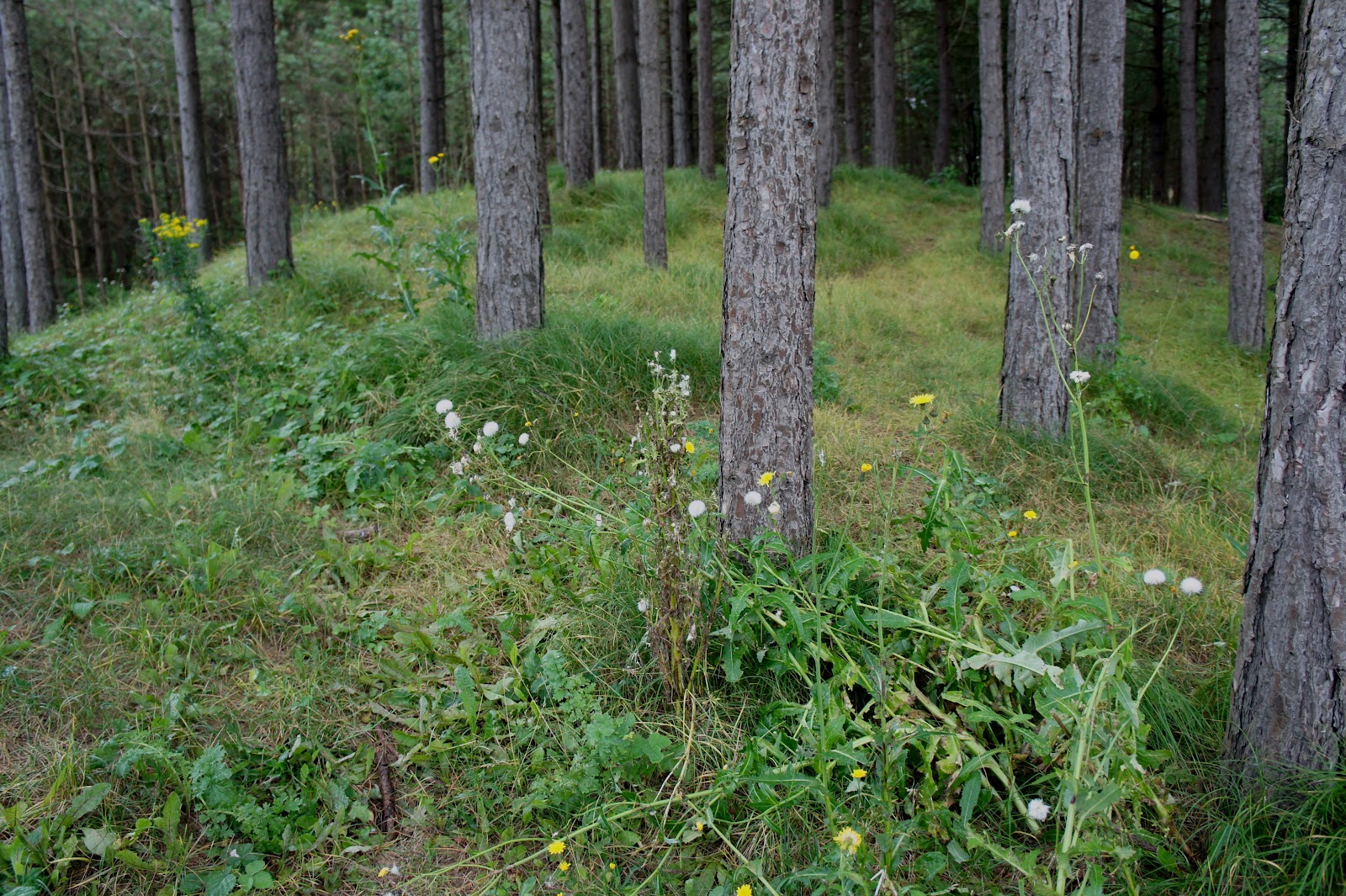
A walk to a beach through pinewoods - the untroubled home of red squirrel,


Across the inconstant sand-dunes - like trying to walk during an anxious dream,

Jumping the waves and then taking off into the sea-coloured skies.

The huge fish skeleton washed ashore is not quite as she seems.

So long since I last saw you,


I glimpse your shimmering peaks and troughs from under an umbrella.

Back through the dampened forest,

One last look.
It is wonderful to read a book so vivid and beautiful that you feel you have actually left the armchair and then reappeared only once the final sentence is read. Then you look around yourself and wonder what is next. 'Strands: A Year of Discoveries on the Beach' by the poet Jean Sprackland was just such a book for me. After four years too far from the emptiness of a coastline, hemmed in by London suburb after suburb, this book took me far away and walked with me hand-in-hand along the Sefton Coast. I was a beachcomber again, finding curious alien creatures washed ashore; ship-wrecks hundreds of years old that rise up from their sandy graves only to disappear for another hundred years and five thousand year old footprints of humans and their ancient forest-dwelling prey - glimpsed for the very first time and then covered again for eternity by the shifting black pre-historic muds.

Today a train, not a book, took us to the very same coastline and I walked through the pages with sandy feet.

Sunday, 12 August 2012

The Explorer's Daughter

 'my parents had spent our first few months in Greenland wondering why my hair never seemed to grow, until finally they discovered that the Eskimos had been cutting off and keeping my curls as protective amulets.'

 A couple of years ago we were staying with friends who live just about as far North as you can go whilst remaining on the British Mainland. Beyond their small village is a long stretch of empty coast dotted with rocks and lighthouses and then seemingly endless sea and sky. Cosily cosseted from the noisy winds that commonly batter the little settlement, seated by the log fire that provides water and heating for the whole house, my friend pressed a dated-looking book into my hands. It was called 'The Snow People' and written by Marie Herbert, the wife of Arctic explorer Wally Herbert over thirty years ago.

 Ostensibly it is an anthropological study, although not in an academic sense, of the Inughuit people of a small island, called coincidentally Herbert Island, in North Greenland. But in reality it is a far more fascinating story of a mother suddenly finding herself and her ten-month-old baby daughter in a completely alien culture to her own and living in the harshest environment imaginable. Wally's adventures travelling across dangerous and unexplored stretches of Arctic Ice seem straightforward when you read the challenges Marie faces. Their family home for two years is a simple hut measuring in total 14 feet by 11 feet usually intended only for visiting hunters. Kari remembers:

'The walls were dark blue and stained with old blood and grime, the windows were cracked, there was no toilet and an all-pervading smell of seal and walrus and general squalor hung in the air. 'We had to paint it immediately,' Dad told me laughing, 'to seal in the smell.''

None of the Eskimos speak English and so in order to communicate with her new community Kari's mother must first learn Danish and then use the Danish books to learn Greenlandic. The community, of necessity, is close-knit both physically and emotionally. Visitors walk in without warning and the village children are a constant presence, curious and enjoying the interesting supplies of English chocolate. Marie must learn to take care of herself and her young baby without being a burden to the community using traditional methods of survival.

  Their closest neighbours, Avatak and Maria have seven children and a well-worn path between the houses becomes testament to the familial warmth between the families. Kari calls their children her brothers and sisters and Avatak 'Ataata' - which is Greenlandic for 'Dad'. One of the saddest scenes in the book is when Marie, Wally and Kari must go home to England. Maria's outlook on life is so clearly broadened by her friendship with Marie; it is hard to witness the world suddenly become so small and claustrophobic for her again.

 Thirty years later Kari revisited her Arctic family and wrote 'The Explorer's Daughter' about her experiences, and best of all it is a story as engaging as her mother's.

 Kari speaks only Greenlandic on her return from her Arctic home to England at the age of two. Thirty years later she speaks pretty much only English. Alongside the joyful reunions of those who recognise little Kari as the charming little child they had adopted as their own, are many sad revelations as we see the consequences on the Inughuit people of the cultural invasion of the rest of the world. Alcoholism and global warming, which were already making an impact in the 1970s have had a devastating affect. Few families hadn't experienced a least one suicide amongst their younger generation and many of the local traditional hunting grounds are now unreachable due to melted ice.  Shockingly we hear that Maria shot and killed her husband Avatak not long after the Herberts' return to England.

 Kari returns to Herbert Island, which has now been abandoned by the population for the larger settlement of Qaanaaq (Thule). Her hut is almost unrecognisable as her one-time home, save for the shelves lovingly put in by her father:

 'the house was littered with belongings: furs, jackets, boots and provisions. In the main room a tin ashtray was filled with nicotine-yellow butts and rings of coffee stained the plastic tablecloths.'

 The hut has returned to being a temporary shelter for visiting hunters. But her adoptive grandfather's hut is just as he left it:

'Aata's faded armchair sat in the corner with his imprint still on the worn cushions. Naduk squeezed past me a plumped herself down in it happily chewing on a thumbnail. I took a sharp intake of breath in surprise, and realized that she had never known her grandfather. Naduk smiled, oblivious to my thoughts.'


The most important part - the photographs!


Kari's identity is so complex. She is neither English girl nor Inughuit, she never quite feels at home in Greenland and yet so many of the community consider her one of their long-lost children. She is able to see her community through the fresh eyes of an outsider yet know each member as personally as a family member might. The moment I closed the pages of 'The Snow People' and 'The Explorer's Daughter' I missed the people of Thule.

Monday, 23 July 2012

Utopia


I have been reading about inclusive Utopias, ones that are open to all and provide a welcome to those damaged by or lost in modern society, in 'Utopian Dreams' by Tobias Jones; an account of his journey to discover another, better way, of living. Simultaneously, we found ourselves beaten by the wind and rain in the unprecedented storm clouds that have hit the UK of late and camping was no longer a solution. So we choose to spend some time in Centre Parcs in Cumbria.


 This Utopia costs money and perhaps even causes more social ills than it solves, but it was a solution to our personal immediate needs. But I found a lot to admire here and learned a little about how our lives could look if only things were organised a little differently.

 When we arrived at Whinfell we thought we would certainly want to escape the village and had planned trips to Penrith and the beautiful surrounding countryside; however in reality we drove up to the wooden house, unpacked our bags, parked the hire car back at the edge of the park and didn't see it again for five days.

 We marvelled, of course, at the clean and organised kitchen and the en-suite bathrooms after having only a share of showers and an outdoor sink for the past weeks. We then visited the huge glass dome with a swimming pool, flumes, slides and river rapids set within a tropical garden. The place was buzzing with people: children, couples and groups of all ages and many with disabilities. There was so much to do and see. In this paradise alone our son spent nearly five hours a day. He was determined to make the most of every moment.

After all the noise and chaos of the 'village' we retreated to the truly impressive stillness of our temporary home. Centre Parcs has been established long enough for the woodland to dominate again. There are hares bounding past and red squirrels knocking pine cones from the great height of the cosseting green canopy above. Families of ducks play in the most unpromising little puddles. We were situated in a closely built cul-de-sac but it was actually tricky to make out any neighbours from the windows. Cars must be parked away from the houses except on moving day and even the bikes cycle only on the main thoroughfares.


 In the silence and stillness of the house, with the aid of a giant blackboard we planned all our activities.


 There was so much to try. We choose zip-lining (plummeting down a line between trees), ceramic painting, badminton, windsurfing, perhaps the most wonderful was the horse-riding. The stables are set overlooking the surrounding fells.

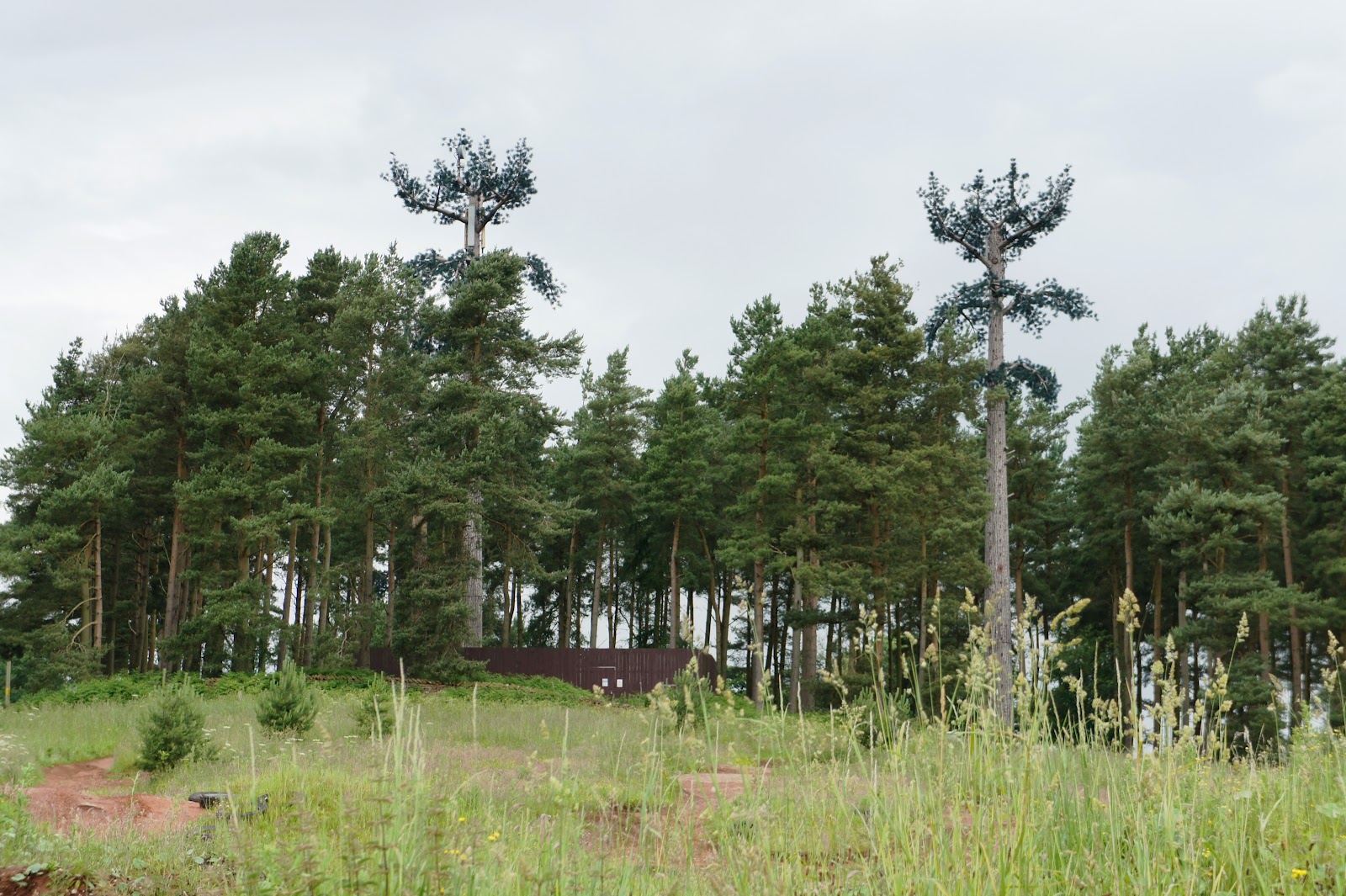
 As with the most sci-fi of Utopias however, even the tress were not quite as they seemed!

 My souvenirs will be fresh ideas: the possibility that a community can hold many people and offer much to occupy them in a small area, yet offer them stillness and a retreat from noise. My other will be this - a huge canvas printed with a large photograph of a tranquil forest. Huge enough to lose oneself in.